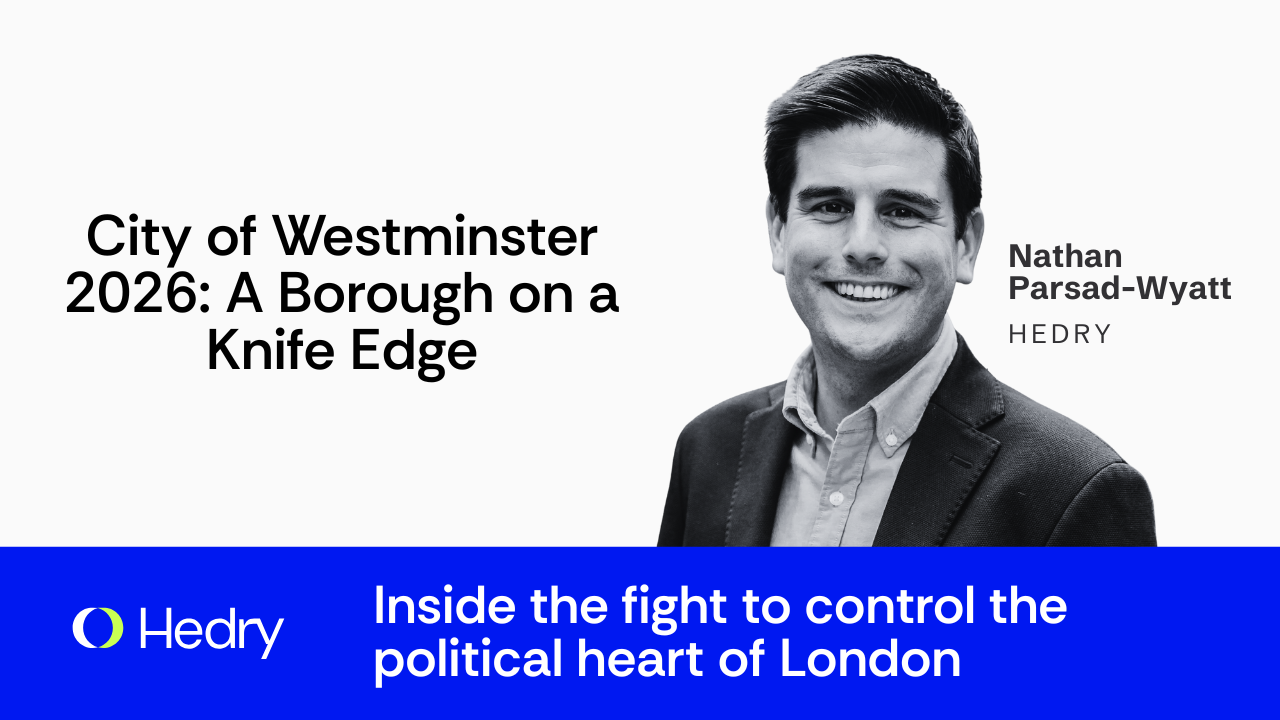
Inside the fight to control the political heart of London
For decades, Westminster City Council embodied Conservative control in London. It was the borough that seemed to defy national tides and symbolised the party’s authority in wealthy central London. That changed in 2022 when Labour captured the council for the first time. It signalled the scale of the Conservatives’ challenge after more than a decade in government and showed how far Labour had come since the Corbyn era to rebuild credibility among London’s professional, globally oriented electorate. Combined with Sir Sadiq Khan’s re-election as Mayor, James Small Edwards AM winning the West Central Assembly seat and Rachel Blake MP taking the Cities of London and Westminster constituency for Labour for the first time, the party appeared to be building a durable coalition across this part of the capital.
Yet three years after the council changed hands the picture looks far less settled.
By elections, high profile defections and an escalating debate with the Mayor of London over the Oxford Street Mayoral Development Corporation have reshaped Westminster’s political map. On top of this, the national Labour government has entered a difficult midterm period. The burst of optimism that followed the 2024 general election has faded as economic pressures; controversial decisions and a series of scandals have taken a toll. Polling through 2025 shows a clear and significant cooling of the Labour vote. This combination of national drift and local volatility means the May 2026 elections will test whether Labour’s 2022 breakthrough was the beginning of a long-term realignment or a high water mark reached under uniquely favourable conditions.
The new arithmetic: a narrowing path to power
Labour entered office with a 31 to 23 majority. That margin has steadily eroded. The Conservatives regained a councillor in West End in September 2024 when Tim Barnes returned to the Town Hall. They took Vincent Square in February 2025 with the election of Martin Hayes. Both were symbolically important and demonstrated a Conservative party recovering confidence and organisation in the centre of the city. Meanwhile Labour’s vote share fell by 27.6 percent in a Harrow Road by election, one of its safest wards. The Greens and a pro Gaza independent took a significant share of Labour’s support, signalling trouble not only from the right but also from the left.
Then came turbulence from unexpected quarters. Labour’s Paul Fisher defected to the Conservatives in the West End, citing frustration with the party and the Mayor’s handling of Oxford Street. In June, Conservative councillor Laila Cunningham, representing Lancaster Gate, quit the party to join Reform UK. Last month a second Conservative, Alan Mendoza, also defected to Reform. Although he cited national reasons, his departure gives Reform two councillors and creates a new threat to the Conservatives from their right flank.
The result is a far more splintered political environment. Labour now governs with only a two-seat majority. The Conservatives are attempting to rebuild while fighting off Reform for parts of their own base. And Labour faces pressure from the other direction. The Greens continue to grow slowly but steadily in renter heavy wards. The emergence of pro Gaza independent candidates adds further risk for Labour’s diverse and progressive voter coalition. In tightly contested wards, even modest shifts towards Greens or independents could change the result. Westminster’s next administration will be shaped not only by the strength of the two main parties but by the cumulative effect of fragmentation across both the left and right.
National weather felt locally
National politics looms over the London elections. The Labour government has struggled after nearly eighteen months in power. Growth remains weak. Taxes are rising. Public services still feel under pressure. The political mood has cooled sharply since the general election. For the Conservatives this is an unexpected opening. Their argument that Labour over promised and under delivered has found a more receptive audience in parts of Westminster.
This discontent does not automatically translate into Conservative enthusiasm, particularly in inner London where social attitudes remain more liberal and more sceptical of the national party. In the by elections of 2024 and 2025 Labour’s vote share dropped sharply, even in wards that had previously been considered safe. Protest votes grew and support splintered in several directions. That is not a pattern Labour can afford in a council where many wards are decided by extremely small margins, often just a handful of votes.
Oxford Street: the lightning rod
Few issues shape the political mood in certain wards more than Oxford Street. The Mayor’s decision to create a Mayoral Development Corporation has defined Westminster politics. The timeline is now fixed. The MDC becomes operational on 1 January 2026 and assumes planning powers on 1 April. This marks a major shift in authority from the council to City Hall.
City Hall argues that the MDC will bring investment and momentum and remove local political rows from the delivery of a critical economic asset. Conservatives frame it as a loss of local control and evidence that Westminster Labour has been unable to stand up to the Mayor. Local Labour positions itself as the pragmatic negotiator, working to secure concessions, but it has undoubtedly created real political challenges.
In the West End ward, which includes Oxford Street, Soho, Mayfair and in Marylebone ward nearby, the issue is particularly charged. Residents fear traffic displacement, accessibility issues, changes to bus routes, congestion in residential streets and more late-night activity. Landlords want confidence and clarity on investment. Retailers want a functioning, well managed national high street. The MDC debate has become a proxy for deeper questions about who governs central London. Read our article on this here.
While Oxford Street will be decisive in some marginal wards, it is not universally salient across the borough. Voters in the north and west are less impacted by the detail, although the broader narrative that the Mayor has overridden local opinion remains politically sensitive.
What Westminster voters are really saying
Recent research commissioned by Hedry points to a borough that feels the strain of day-to-day pressures. Residents express pride in living in a world-famous city, but frustration is widespread and highly localised.
The strongest and most consistent themes are about the basics. Many voters feel the streets look and feel less well managed than they did a few years ago, and concerns about anti-social behaviour, nuisance riding, e-bikes, begging and visible disorder feature prominently. For a significant number of residents this is not an abstract debate about policing priorities but a direct measure of whether the fundamentals are right.
Housing dissatisfaction is acute in the north and west of the borough. Complaints centre less on new development and more on the reliability of repairs, the quality of maintenance and the speed of responses. Even small service failures appear to shape wider political perceptions.
Among businesses and workers in central Westminster there is a growing sense of drift. They want planning and licensing decisions to be clearer, quicker and more predictable.
Views on public realm changes are more divided. Many residents welcome investment, greener streets and safer walking routes, but there is real anxiety about how changes are phased and the impact on traffic, buses and accessibility. Execution and communication matter as much as the principle of improvement.
Across all groups there is a noticeable desire for more visible leadership and accountability. Voters increasingly distinguish between the roles of the council, the Mayor and national government. They want somebody to take responsibility and act decisively. And with the national Labour government becoming less popular, some Labour leaning voters say they feel less certain they want to reinforce the party locally.
Taken together, these attitudes make the electoral landscape more volatile than headline numbers alone would suggest. Residents are not in a mood to reward any party reflexively, and their expectations on local delivery have risen, not fallen, since 2022.
Inside the campaigns: confidence, caution and quiet anxiety
Behind the scenes both major parties are adapting their strategies to a far more unpredictable contest.
The Conservative campaign aims to project confidence without complacency. Strategists say privately that they are working for every vote and are not taking anything for granted. They recognise the mountain they must climb but also believe the political mood is drifting in their favour. Their internal message is simple: anything can happen between now and May, so organisation and discipline will matter as much as momentum.
Labour’s campaign mood is more sober. Activists acknowledge the difficulty of the fight but believe they have a positive local legacy to defend. Their approach centres on incumbency, visibility and local delivery. They aim to show voters that whatever the national mood, Westminster Labour can be trusted to run services, support neighbourhoods and listen to residents.
Both parties know that small shifts in turnout, postal votes or tactical behaviour could decide control of the borough.
The battleground map: where control will be won and lost
Control of Westminster will be decided in a small number of highly competitive wards.
West End is one of the most politically active and organised communities in London. The Conservatives were able to win a councillor in 2024 with an eight percent increase in their vote, but both parties are targeting it intensely.
Vincent Square contains a diverse population but, given its core vote profile, should probably not have been lost by the Conservatives in 2022.
Lancaster Gate, decided by only two votes in 2022, now features a Reform councillor and a Labour incumbent standing down, making it highly unpredictable.
Hyde Park is competitive following the retirement of Labour veteran Paul Dimoldenberg.
Little Venice remains delicately balanced. Bayswater and Pimlico South are also on the marginal list.
The presence of Greens, independents and Reform candidates across the borough will affect outcomes. The marginal wards are now more marginal than ever, and results are likely to come down to a very small portion of votes.
Both main parties have completed most of their selections. Labour relies heavily on incumbency and community candidates but must navigate several sitting councillors stepping down. The Conservatives have refreshed their slate with new candidates in certain wards and familiar faces in some areas.
Fragmentation: the smaller parties that could decide the outcome
Reform UK’s vote remains relatively small but could be consequential. A few hundred votes in the wrong place could cost the Conservatives a ward they would otherwise expect to win. The Greens continue to build support among younger renters. The Liberal Democrats retain concentrated pockets. Pro Gaza independents could draw progressive votes away from Labour in key wards.
In a borough where many wards are decided by less than very small percentages of the vote, fragmentation matters. Both major parties will be working hard to convince voters that Westminster is a direct contest between Labour and the Conservatives and that no one else can realistically win here.
Scenarios for May 2026
Three outcomes remain plausible.
- A Conservative return to control, built on their by election gains, a plan to respond to residents concerns and national dissatisfaction with Labour.
- A narrow Labour hold, reliant on strong incumbency and a well organised ground campaign where Reform fragments the right more than the Greens or independents fragment the left.
- Or no overall control, where one or two surprise ward results from Reform, Greens, Liberal Democrats or independents create a finely balanced council and force a minority administration.
The bottom line
Westminster enters 2026 as one of the most competitive local elections in Britain. A borough that once symbolised Conservative dominance and then Labour resurgence is now a knife edge contest shaped by national mood, local delivery and a fragmented political landscape. For the Conservatives, winning back Westminster would be a powerful signal that they can compete again in the capital. For Labour, holding the council would show that the 2022 victory was not a high-water mark but a foundation for longer term political strength in central London. With five months until polling day, expect the campaign to intensify quickly.
Nathan Parsad-Wyatt
Nathan Parsad Wyatt is Director & Co-Founder of Hedry and has been involved in Westminster politics for more than a decade, running campaigns and helping commercial clients navigate the borough’s political and planning environment. Hedry advises clients across the political spectrum and has a deep understanding of the political and stakeholder dynamics that shape the City of Westminster. Our team has supported major regeneration projects, planning applications, public realm programmes and policy engagement across more than eighty projects in the borough. To discuss how this shifting landscape may affect your organisation or to shape a tailored strategy, contact Nathan at nathan.parsad wyatt@hedry.co.uk or 07738 589 220.